

 en
en  English
 Español


Content
- 1 Why the Material of the Bottle Matters More Than You Think
- 2 Pump vs. Flip Cap vs. Press Cap: Which Dispenser Works Best?
- 3 Capacity Guide: How Much Shower Gel Do You Actually Need?
- 4 Ergonomics and Grip: Small Details with a Big Impact
- 5 Sealing and Leak Resistance: What to Check Before You Buy
- 6 Labeling, Customization, and Branding Considerations
- 7 Key Questions to Ask Before Making a Final Decision
Choosing a shower gel bottle might seem straightforward, but the wrong choice can lead to leaking pumps, cracked caps, or bottles that tip over the moment you reach for them. Whether you're stocking a hotel bathroom, sourcing packaging for your own brand, or simply upgrading your daily shower routine, understanding what separates a well-designed shower gel bottle from a frustrating one makes all the difference. This guide breaks down every factor worth considering — so you can buy with confidence.
Why the Material of the Bottle Matters More Than You Think
The material used to manufacture a shower gel bottle directly affects durability, chemical compatibility, and environmental impact. The most common options are PET, HDPE, PP, and glass — each with distinct trade-offs.
PET (polyethylene terephthalate) is lightweight, transparent, and resistant to impact, making it ideal for retail shower gel products. It handles most surfactant-based formulas well without degradation. HDPE is more opaque but offers superior chemical resistance, which is why it's common in professional and salon-grade packaging. PP (polypropylene) is often used for caps and pumps due to its rigidity and heat resistance.
Glass bottles, while premium in appearance, are rarely practical in wet shower environments due to breakage risk. For households with children or high-traffic bathrooms, sticking to durable plastic — particularly shatter-resistant PET or HDPE — is the safer, more functional choice.
Sustainability is also increasingly relevant. Look for bottles marked with recycled content (rPET or rHDPE) or those compatible with refill programs. Some brands now offer bottles with a minimum of 50% post-consumer recycled material without compromising structural integrity.
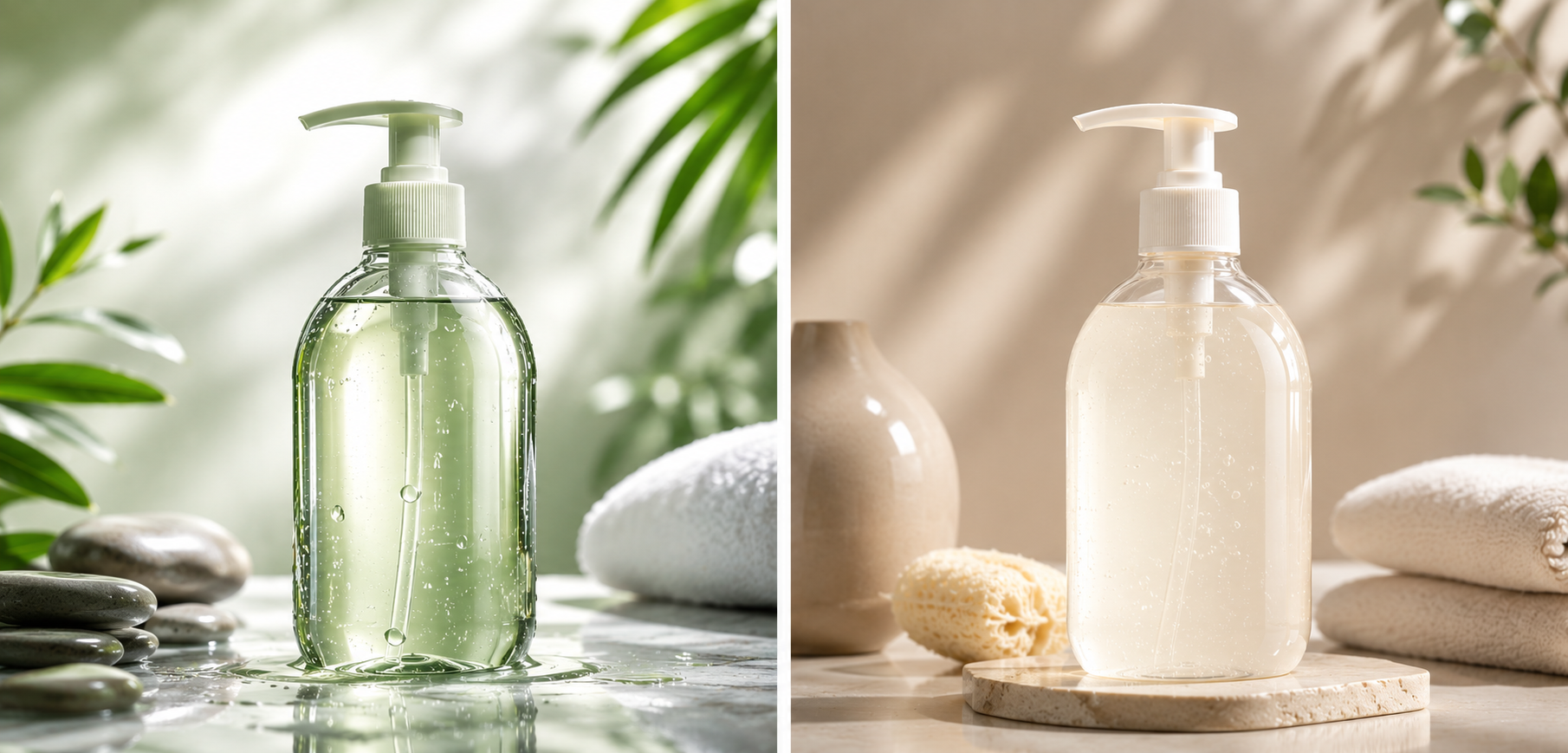
Pump vs. Flip Cap vs. Press Cap: Which Dispenser Works Best?
The dispensing mechanism is one of the most critical — and most overlooked — elements of a shower gel bottle. It determines how much product you use per application, whether leaks occur during storage, and how easy the bottle is to operate with wet, soapy hands.
Pump Dispensers
Pump dispensers are the most popular option for larger bottles (250ml and above). A well-calibrated pump typically delivers 1–2ml per press, helping control usage and reduce waste. Look for pumps with a locking mechanism for travel or storage, and a spring-free design that prevents gel from drying inside the nozzle. Pumps with a wider base tube ensure the bottle can be used until nearly empty, which is a common weak point in cheaper versions.
Flip-Top Caps
Flip-top caps are lightweight and cost-effective, commonly found on travel-size or mid-range bottles. They work well for low-viscosity formulas but can struggle with thicker gels, which tend to clog the opening or dispense unevenly. The hinge is also a common failure point — a reinforced double-hinge design significantly extends cap lifespan.
Press or Disc Caps
Press caps (also called disc tops) offer a clean, minimalist aesthetic and are increasingly popular in premium personal care brands. They're leak-resistant and easy to operate one-handed, though they require the bottle to be inverted or squeezed, which can be less intuitive for first-time users.
Capacity Guide: How Much Shower Gel Do You Actually Need?
Bottle capacity should match your usage pattern — not just look good on a shelf. Here's a quick reference for common use cases:
| Capacity | Best For | Typical Usage Duration |
|---|---|---|
| 50–100ml | Travel, hotel amenities | 3–7 days |
| 250–300ml | Individual daily use | 3–5 weeks |
| 500ml | Family use, gym/spa | 6–10 weeks |
| 1000ml+ | Refill stations, commercial use | Varies by traffic |
Note that larger bottles need to be designed with stability in mind. A 500ml bottle with a narrow base and a top-heavy pump is an accident waiting to happen in a wet shower. Prioritize wide, flat-bottomed designs for anything above 300ml.
Ergonomics and Grip: Small Details with a Big Impact
A shower gel bottle is used in one of the most slippery environments imaginable. Ergonomic design isn't a luxury — it's a safety feature. Key design elements that improve usability include:
- Textured or ribbed side panels that maintain grip when the bottle is wet or covered in soap
- An indented waist or thumb grip that positions the hand naturally for single-handed use
- A flat back panel that allows the bottle to rest against a shower wall or shelf without rolling
- Raised label areas or braille indicators for households with visually impaired members
Don't underestimate the importance of weight distribution. A bottle that feels balanced when full may become top-heavy once it's half-empty if the pump head is particularly heavy. This is especially relevant for wall-mounted or shower caddy placements where stability is critical.
Sealing and Leak Resistance: What to Check Before You Buy
Leaking shower gel bottles are among the most common complaints in both consumer reviews and hospitality supply feedback. The good news is that most leaks are preventable if you know what to look for.
For pump bottles, check whether the pump head can be locked by twisting or pressing down. A bottle without a travel lock will almost certainly leak if tipped or stored on its side. For flip-cap and disc-cap models, inspect the seal tightness — the cap should click audibly when closed, indicating a snug fit. Avoid caps that feel loose or require force to stay shut, as the hinge will fatigue quickly.
The neck threading between cap and bottle body is another failure point. Look for at least 3–4 full thread turns for a secure fit. Bottles with over-molded or heat-bonded seals around the pump collar offer better long-term resistance to leakage than those relying purely on compression fits.
If you're sourcing shower gel bottles in bulk for a brand or hospitality business, always request a drop-test certification or leakage test report from the manufacturer. Reputable suppliers test to ASTM D5276 or ISTA standards and can provide documentation on request.
Labeling, Customization, and Branding Considerations
For businesses sourcing shower gel bottles to fill with their own product, the bottle's surface is prime real estate. A few key factors to evaluate:
- Label panel area: The flat or slightly curved panel on the front of the bottle should be large enough to accommodate your label design without distortion. Avoid highly curved bottles if your label includes fine print or detailed graphics.
- Direct printing vs. label: Bottles with smooth, matte finishes accept pressure-sensitive labels well. If you want screen printing or hot-stamping directly on the bottle, confirm the surface treatment is compatible with your chosen ink or foil system.
- Shrink sleeve compatibility: If you're using full-wrap shrink sleeve labels, ensure the bottle has no undercuts or deep grooves that would prevent the sleeve from conforming properly during the heat tunnel process.
- Custom mold options: For high-volume orders (typically 50,000 units or more), many manufacturers offer custom bottle molds. This allows you to create a distinctive shape that sets your brand apart from competitors using stock packaging.
For smaller runs, stock bottle designs with custom labeling are the most cost-effective path. A 250ml or 300ml round bottle in clear PET remains the most versatile and universally compatible option for most personal care brands entering the market.
Key Questions to Ask Before Making a Final Decision
Before committing to a shower gel bottle — whether for personal use or commercial sourcing — run through this checklist:
- Is the material compatible with your formula's pH and active ingredients?
- Does the dispensing mechanism match the viscosity of your gel (thin, medium, or thick)?
- Is the bottle stable on a wet surface, or does it require a non-slip mat or holder?
- Does the cap or pump have a reliable leak-prevention feature for storage and transport?
- Is the bottle recyclable or refillable if sustainability is a priority?
- For branded products: is there sufficient label area and surface compatibility for your printing method?
The best shower gel bottle is not necessarily the most expensive one — it's the one that performs reliably in your specific context. Taking the time to evaluate material, dispenser type, capacity, stability, and seal quality before purchasing will save you from costly returns, reformulations, or disappointed customers down the line.
