en
en  English
 Español


Content
- 1 Why printing quality is a packaging decision, not an afterthought
- 2 Screen printing: the workhorse of daily chemical bottles
- 3 Hot stamping: the premium signal for skin care and toner bottles
- 4 Pad printing and offset: reaching difficult geometries
- 5 Digital printing and IML: the short-run and complexity premium
- 6 Choosing by application: a practical summary
- 7 Manufacturing quality as the decisive variable
From PET toner bottles to PE body wash containers, the printing process applied to a plastic bottle shapes durability, colour fidelity, and brand shelf impact more than most brand managers realise.
Why printing quality is a packaging decision, not an afterthought
A personal care bottle is a brand’s most persistent ambassador. It sits on a bathroom shelf, travels in luggage, and reappears in social media flat-lays and unboxing videos. The printing on that bottle — its crispness, its colour consistency, its resistance to steam and friction — communicates brand investment long after the purchase decision has been made. For skin care bottles, detergent bottles, spray bottles, and daily chemical containers alike, printing quality is not a secondary specification. It is a primary brand experience variable.
The challenge is that plastic bottles present a uniquely demanding surface for print. Curved geometries, flexible substrates, humid end-use environments, and the chemical aggression of surfactant spills all conspire to degrade lesser print solutions. Understanding which process is genuinely suited to each application — PET toner bottles, PE body care bottles, PP spray bottles, and so on — requires cutting through marketing claims to examine what each technology actually delivers in production conditions.
Screen printing: the workhorse of daily chemical bottles
Screen printing remains the most widely used direct-print process for personal care plastic bottles, and its dominance is deserved. The process lays down a thick ink film that bonds chemically with the substrate surface — particularly effective on PE body care bottles and PP detergent bottles where surface energy is a known adhesion challenge. When properly applied with UV-curable inks, screen-printed graphics on plastic bottles resist the combined effects of moisture, friction, and cleaning agents better than most alternative methods.
For daily chemical bottles and body care bottles produced in significant volume, screen printing’s economics are compelling. Setup costs are modest at scale, cycle times are fast, and the process handles the standardised, bold graphic vocabularies that dominate this product category — solid colour fills, brand logotypes, regulatory text — without difficulty. Its primary limitation is colour count: each colour requires a separate screen and pass, making highly complex photographic or gradient-rich artwork impractical and expensive.
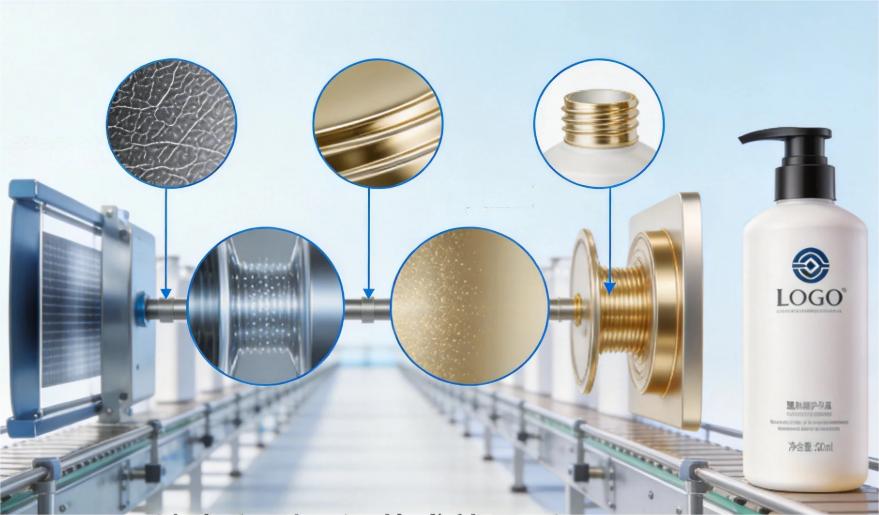
No ink-based process replicates the visual effect of hot stamping. The metallic and holographic foils available through hot stamping deliver a reflective quality that immediately elevates a bottle’s perceived price point. For plastic toner bottles, skin care bottles, and premium personal care product lines where shelf distinction is a primary purchase driver, hot stamping provides a differentiation that is both visually immediate and tactilely engaging.
The process is precise and repeatable, making it well-suited to fine logotype work, decorative borders, and the kind of restrained accent detailing that characterises luxury personal care packaging. It works effectively on PET bottles, where the rigid surface provides consistent die contact, and on PP components including caps and pump collars. The investment in tooling is recovered rapidly on medium-to-high volume runs, and the resulting finish requires no additional coating or protection — the foil is inherently durable against the damp conditions of bathroom environments.
“Hot stamping does not simply add shine — it adds a quality signal that consumers have been conditioned to associate with premium positioning, across every personal care category from toners to body oils.”
Pad printing and offset: reaching difficult geometries
Spray bottles, trigger dispensers, and personal care containers with pronounced shoulders or narrow cylindrical necks present surface access challenges that flat-press methods cannot solve. Pad printing addresses this through its flexible silicone transfer medium, which conforms to irregular surfaces and deposits ink precisely onto areas that would otherwise be unreachable. The process excels for small, detailed graphics — batch codes, secondary logotypes, directional symbols — on complex bottle profiles.
Offset printing, adapted for cylindrical surfaces via rotary mandrel systems, delivers finer halftone resolution than screen printing and is preferred where multi-colour photographic reproduction is required directly on the bottle without a label carrier. Both processes suit mid-complexity personal care products where branding detail matters but label application is not preferred.
Digital direct printing has transformed the economics of small-batch personal care packaging. For emerging skin care brands, seasonal limited editions, or market-test quantities, the absence of plate costs makes digital the only viable direct-print option. Modern UV-cured digital printing on plastic bottles delivers colour gamuts and fine-line resolution that approach offset quality, and the technology’s improving compatibility with PE and PP substrates is narrowing the adhesion gap that once limited its application.
In-mould labelling (IML) occupies a different tier of complexity and investment. By fusing a pre-printed label into the bottle wall during the moulding process itself, IML delivers seamless, flush-surface graphics with photographic-quality colour reproduction across the full bottle body. The result is a container where the decoration appears to be part of the material rather than applied to it — a finish that is particularly effective for premium body care bottles and personal care product lines where surface continuity and damage resistance are both requirements.
Choosing by application: a practical summary
| Process | Best bottle type | Colour range | Durability | MOQ suitability |
| Screen printing | PE/PP body care, detergent, spray | 1–6 colours | High | Medium–high volume |
| Hot stamping | PET toner, skin care, premium caps | Metallic/foil | High | Medium–high volume |
| Pad / offset | Spray bottles, complex profiles | 1–4 colours | Medium | Medium volume |
| Digital direct | All substrates, short runs | Full colour | Medium | Low–medium volume |
| IML / label | PE/PP full-body decoration | Full colour | Very high | Medium–high volume |
Manufacturing quality as the decisive variable
Understanding the differences between printing processes matters — but the quality of execution within any given process matters more. A screen print applied with inconsistent pressure, misaligned registration, or incompatible ink chemistry will underperform regardless of whether screen printing was the right process choice. The same principle holds for hot stamping on PET toner bottles, digital printing on skin care bottles, and IML on daily chemical containers.
Brotherpacking’s approach to personal care product packaging integrates printing process selection with manufacturing quality control from the first sample through to full production. With a defect-free rate consistently above 99% and a production infrastructure capable of handling multiple print technologies across PET, PE, and PP substrates, the capability to match the right process to each bottle type — and to execute that process at the standard premium brands require — is built into every order. For personal care brands where the bottle on the shelf is as important as the formulation inside it, that manufacturing discipline is the advantage that holds.