en
en  English
 Español


Content
- 1 Why the material choice is a branding decision
- 2 The three materials at a glance
- 3 PET: the clarity benchmark for personal care packaging
- 4 PE: the functional standard for hair care bottles
- 5 PP: precision performance for specialised formats
- 6 Choosing the right resin: a decision framework
- 7 Brotherpacking’s material advantage
A material decision that looks technical on the surface shapes how consumers perceive a brand at the shelf, in the shower, and at the point of repurchase. Brotherpacking breaks down what each resin does — and what it signals.
Why the material choice is a branding decision
Walk into any pharmacy or beauty retailer and the shelf tells a story before a single ingredient is read. The clarity of a shampoo bottle, the soft squeeze of a conditioner tube, the reassuring weight of a premium serum container — all of these tactile and visual impressions are, fundamentally, material decisions. In personal care products packaging, the choice between PET, PE, and PP is not merely a procurement question. It is a brand positioning question.
For hair care bottles in particular, the stakes are high. Consumers interact with these products daily, often in humid, pressured environments — the shower, the bathroom counter, the gym bag. The resin that performs best in a laboratory specification sheet may not be the resin that performs best in a consumer’s lived experience. Understanding the practical and perceptual differences between PET, PE, and PP is therefore essential for any brand operating in personal care.
The three materials at a glance
PET
Polyethylene terephthalate
High clarity, rigid structure, strong barrier properties. The premium visual standard for personal care.
PE
Polyethylene (HDPE / LDPE)
Flexible, impact-resistant, chemically compatible with a wide range of formulations. The functional workhorse.
PP
Polypropylene
Heat-tolerant, lightweight, semi-rigid. Ideal for dispensing systems and specialty care formats.
PET: the clarity benchmark for personal care packaging
PET has become the default choice for brands that want their product to be seen. Its glass-like transparency is unmatched among common packaging resins, making it the natural selection for serums, toners, specialty hair oils, and any formulation where the product itself — its colour, its texture, its visual purity — is part of the marketing story. PET bottles communicate quality before the cap is opened.
Beyond aesthetics, PET offers excellent barrier performance against oxygen and moisture, which matters for formulations sensitive to oxidation or contamination. It is also dimensionally stable, meaning the bottle holds its shape under retail stacking conditions and maintains its premium appearance throughout its shelf life. For hair care brands positioned at the mid-to-premium end of the market, PET is frequently the default choice precisely because it signals investment and care.
The limitation of PET is its rigidity. It does not lend itself to squeeze-dispensing formats, which limits its application in rinse-off products like shampoos and conditioners where consumers expect to express the product with one hand. PET is also less forgiving of impact — a dropped PET bottle is more likely to crack than a PE equivalent.
PE: the functional standard for hair care bottles
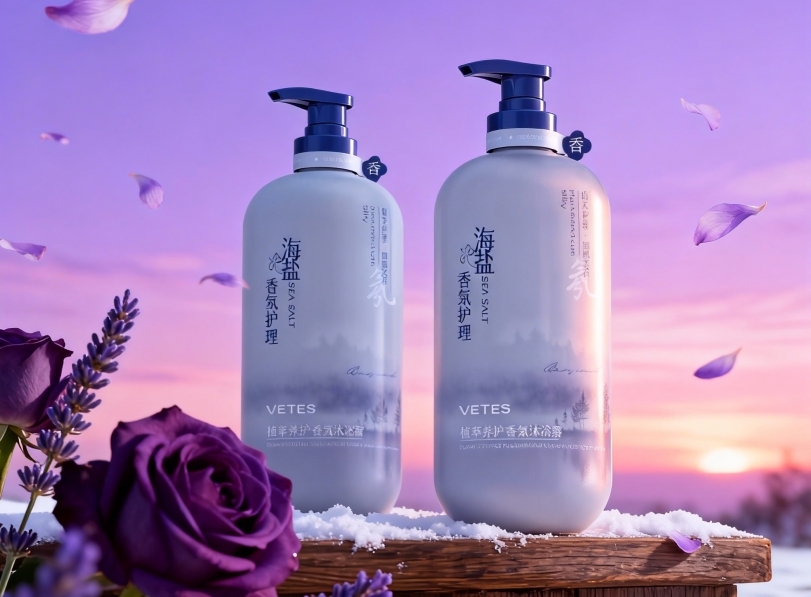
High-density polyethylene (HDPE) and low-density polyethylene (LDPE) together form the backbone of the hair care bottle market. The reason is simple: PE’s flexibility, chemical compatibility, and impact resistance make it ideally suited to the way consumers actually use shampoo, conditioner, and styling products. A bottle that can be squeezed, dropped, left open in a steamy shower, and still perform consistently is a PE bottle.
HDPE offers greater rigidity and is commonly used in larger-format bottles — family-size shampoos, professional salon products, and refill packs — where structural integrity under weight is important. LDPE delivers greater softness and is preferred in formats where a controlled, gentle squeeze is part of the product experience. Both variants accept colour pigmentation readily, enabling the vivid, on-brand packaging aesthetics that hair care marketing depends on.
PE is also highly compatible with a wide range of surfactant-based formulations, including the sulphate systems, silicone emulsions, and botanical extracts that populate contemporary hair care ranges. Chemical compatibility is not a secondary concern — the wrong resin can interact with active ingredients, alter fragrance profiles, or compromise preservative systems over time.
“For daily-use hair care bottles, PE’s flexibility and chemical tolerance make it the most forgiving resin in real-world consumer conditions — the shower being the most demanding environment a bottle will ever face.”
PP: precision performance for specialised formats
Polypropylene fills a specific and important role in personal care products packaging. Its higher melting point makes it the preferred choice where heat resistance is required — hot-fill processes, products used near heat styling tools, or packaging that must pass through warm distribution environments without distorting. PP is also the standard resin for pump dispensers, flip-top caps, and trigger components, where its combination of stiffness, fatigue resistance, and precise moulding tolerances is essential.
In hair care specifically, PP appears most frequently in treatment products — leave-in conditioners, heat protectants, scalp serums — where dispensing precision and product differentiation matter. The semi-rigid character of PP allows for structural design details that communicate premium positioning without the full rigidity of PET. It also performs well with emulsion-based formulations and oil-in-water systems that are common in intensive hair treatment products.
Choosing the right resin: a decision framework
| Criterion | PET | PE (HDPE/LDPE) | PP |
| Transparency | Glass-like clarity | Translucent to opaque | Semi-transparent |
| Flexibility | Rigid | Flexible to semi-rigid | Semi-rigid |
| Heat resistance | Moderate | Moderate (HDPE higher) | High |
| Chemical compatibility | Good (avoid strong bases) | Excellent | Excellent |
| Best application | Serums, oils, premium rinse-off | Shampoo, conditioner, body wash | Treatments, pumps, caps |
| Sustainability pathway | rPET widely available | PCR-PE increasing | Recyclable, growing PCR |
Brotherpacking’s material advantage
Understanding the differences between PET, PE, and PP is one thing. Producing consistently across all three — at volume, at speed, and at the quality levels that personal care brands demand — is another. Brotherpacking’s manufacturing infrastructure is built for exactly this flexibility. Its injection and blow molding lines are configured to handle multiple resin systems, with process parameters optimised for each material’s specific behaviour during moulding, cooling, and finishing.
YIELD RATE
99%+ across all resin types
RESPONSE CYCLE
30% faster order turnaround
MATERIAL RANGE
PET, PE, PP & recycled variants
For brands developing new hair care lines or refreshing existing packaging, this multi-material capability removes a common friction point: the need to work with separate suppliers for different resin types. Brotherpacking consolidates that complexity, offering a single manufacturing partner capable of delivering PET serums, PE shampoo bottles, and PP treatment dispensers to a unified quality standard and timeline.
The result is not just operational efficiency — it is brand consistency. When every bottle in a product range, regardless of resin, meets the same finish standard and dimensional tolerance, the shelf impact is coherent and the brand story holds. In personal care products packaging, that coherence is the competitive advantage that turns a first purchase into a repeat one.