

 en
en  English
 Español


Content
- 1 What Makes a PE Square Bottle Genuinely Durable
- 2 Key Industries That Depend on PE Square Bottles
- 3 How to Select the Right PE Square Bottle for Your Application
- 4 Manufacturing Processes Behind a Durable Square Bottle
- 5 Sustainability Considerations for PE Square Bottles
- 6 Common Specification Mistakes to Avoid When Sourcing PE Square Bottles
What Makes a PE Square Bottle Genuinely Durable
Not every polyethylene bottle marketed as "durable" lives up to that claim in practice. True durability in a PE square bottle is determined by a combination of resin grade, wall thickness, manufacturing process, and structural geometry — and understanding how these factors interact is the first step to selecting a container that performs reliably across its full service life.
Polyethylene exists in several grades, and the choice of resin has a direct and measurable impact on bottle strength. High-Density Polyethylene (HDPE) is the dominant material for durable square bottles because its tightly packed molecular structure delivers a tensile strength of 20–37 MPa, excellent chemical resistance, and a high stiffness-to-weight ratio. HDPE square bottles resist cracking under load, maintain dimensional stability across a wide temperature range (typically −40°C to +60°C), and do not absorb moisture, making them suitable for long-term storage of both liquid and semi-liquid contents. Low-Density Polyethylene (LDPE) is occasionally used where squeeze flexibility is needed, but it sacrifices structural rigidity and is less suited to applications requiring stackability or drop resistance.
Wall thickness is equally critical. For industrial-use PE square bottles in the 1–5 litre range, a minimum wall thickness of 1.5–2.0 mm is standard for routine chemical storage. Bottles intended for transportation of hazardous materials under UN certification are typically manufactured to wall thicknesses of 2.5 mm or above, with reinforced corner geometry to absorb impact energy at the points most vulnerable to stress during drops. The square profile itself contributes to rigidity — flat panels resist deformation under internal pressure more efficiently than curved surfaces of equivalent gauge, which is why square bottles often outperform round bottles of the same wall thickness in compression stacking tests.
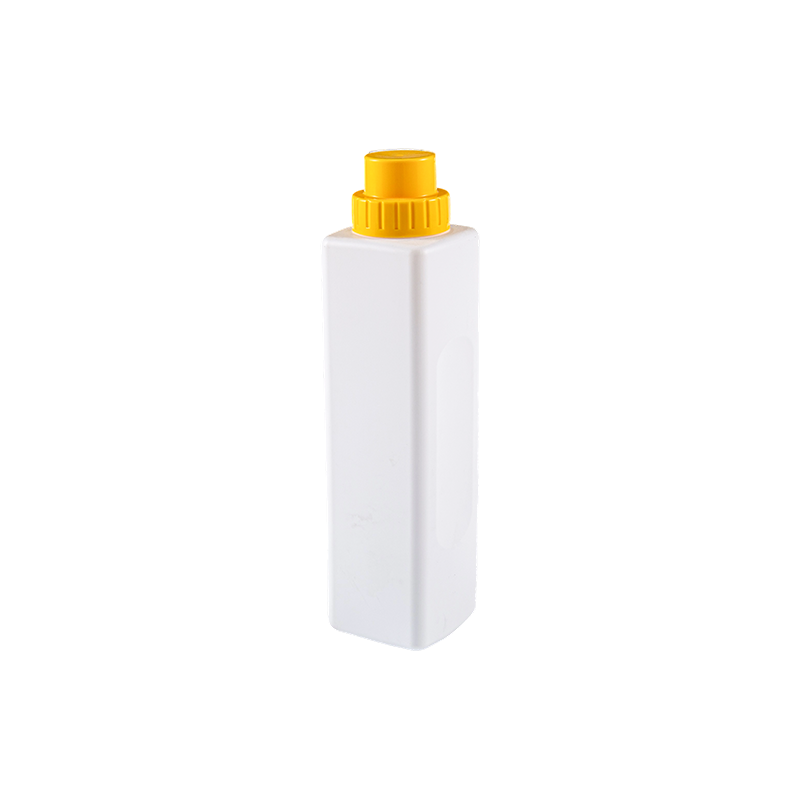
Key Industries That Depend on PE Square Bottles
The durable PE square bottle has become the de facto standard container in several demanding sectors precisely because it combines chemical inertness, mechanical toughness, and geometry-driven storage efficiency. The following industries rely on it most heavily — and their specific requirements illustrate the range of performance a well-specified PE square bottle must deliver.
Agriculture and Agrochemicals
Pesticides, herbicides, liquid fertilisers, and soil conditioners are among the most chemically aggressive products regularly packaged in PE square bottles. HDPE's resistance to a broad spectrum of organic solvents, acids, and alkalis makes it the only cost-effective plastic option for this sector. Agrochemical-grade square bottles in the 1–5 litre range are routinely UN-certified for transport, requiring them to pass 1.2-metre drop tests, stack pressure tests at three times the filled bottle weight for 28 days, and leakage tests under internal pressure. The square format is preferred because it maximises pallet density — a meaningful cost factor when shipping product to rural distribution points across large geographies.
Industrial Chemicals and Lubricants
Engine oils, hydraulic fluids, industrial cleaners, and specialty solvents require containers that remain leak-free under the temperature cycling experienced in warehouse and workshop environments. HDPE square bottles in the 2–20 litre range dominate this segment. Manufacturers serving this market often specify fluorination treatment — a post-moulding surface modification that cross-links the inner wall to reduce permeation of hydrocarbon solvents by up to 90%, significantly extending the effective shelf life of solvent-based products stored in standard HDPE bottles.
Food, Beverage, and Nutritional Products
Food-grade HDPE square bottles are used for cooking oils, syrups, liquid nutritional supplements, and condiment bases. Food-contact compliance requires the resin to meet standards such as FDA 21 CFR 177.1520, EU Regulation 10/2011, or equivalent national standards, confirming that the plastic does not migrate harmful substances into the contents. Square bottles are particularly favoured by food producers because they are easy to label on four flat faces, allowing branding, regulatory text, nutritional information, and barcodes to be applied without distortion — a significant advantage over curved round containers in high-speed labelling lines.
Household and Institutional Cleaning Products
Bleach, disinfectants, multi-surface cleaners, and concentrated detergents place alkaline and oxidative stress on their containers. HDPE square bottles in the 500 ml to 5 litre range are the industry standard here. Ergonomic handle design — integrated into the square profile during blow moulding — is a key feature in this segment, allowing users to pour accurately from large bottles without risk of dropping or spilling. Child-resistant closure compatibility is a further requirement for many household chemical formulations.
How to Select the Right PE Square Bottle for Your Application
Choosing a durable PE square bottle requires matching the bottle specification to the specific demands of the product, the supply chain, and the end user. The following table summarises the most important selection parameters and the values appropriate for common application types:
| Parameter | Agrochemical | Food-Grade | Industrial Chemical |
|---|---|---|---|
| Resin Grade | Virgin HDPE | Food-grade Virgin HDPE | HDPE (fluorinated optional) |
| Wall Thickness | 2.0–2.5 mm+ | 1.5–2.0 mm | 2.0–3.0 mm |
| UN Certification | Required | Not required | Required for hazmat |
| UV Stabiliser | Recommended | Optional | Application-specific |
| Closure Type | Tamper-evident | Standard screw cap | Tamper-evident / vented |
| Recyclability | HDPE (02) | HDPE (02) | HDPE (02) |
Beyond the parameters in the table, buyers should also evaluate neck finish compatibility with their filling and capping equipment, base design (a recessed or ribbed base significantly improves stacking stability on uneven warehouse floors), and handle placement relative to the centre of gravity of the filled bottle — a poorly positioned handle on a heavy bottle increases the risk of spillage during pouring.
Manufacturing Processes Behind a Durable Square Bottle
The dominant production method for PE square bottles is extrusion blow moulding (EBM), in which molten HDPE is extruded as a hollow tube (parison), clamped in a square mould, and inflated with compressed air to take the mould's shape. The EBM process is well-suited to producing the flat-panel geometry of square bottles with consistent wall thickness, though managing material distribution in the corners — where the parison stretches most — requires careful process control to avoid thin spots that reduce structural integrity.
For smaller, high-precision square bottles — particularly in the pharmaceutical and personal care segments — injection stretch blow moulding (ISBM) is used. ISBM produces bottles with tighter dimensional tolerances and more uniform wall thickness than EBM, but the tooling costs are significantly higher, making it economical only at large production volumes. For most industrial and agrochemical square bottle applications, EBM remains the preferred process due to its flexibility, speed, and lower tooling investment.
Quality manufacturers implement inline quality controls including:
- Weight monitoring on every bottle to detect resin under-fill, which directly reduces wall thickness and durability.
- Leak testing using pressurised air to identify pinhole defects before bottles enter the supply chain.
- Top-load compression testing on sampled bottles to verify stacking strength meets specification for palletised shipment.
- Drop testing on filled and capped bottles in standard orientations to confirm closure integrity and bottle survival.
Sustainability Considerations for PE Square Bottles
HDPE is one of the most widely recycled plastics globally, identified by the resin identification code 02. PE square bottles, when manufactured from virgin or post-consumer recycled (PCR) HDPE and properly collected after use, can re-enter the materials stream as regrind for non-food-contact applications or as feedstock for chemical recycling processes. The durability of HDPE itself contributes to sustainability: a thicker, more robust bottle that survives its entire intended service life without failure generates less waste than a cheaper, thinner bottle that splits or leaks prematurely and must be replaced.
Several manufacturers are now offering square bottles with 30–50% post-consumer recycled HDPE content for non-food, non-hazmat applications, reducing the carbon footprint of the container without compromising mechanical performance for lower-stress use cases. For agrochemical and food-contact applications, where regulatory restrictions limit the use of recycled content in primary packaging, lightweighting — achieving equivalent strength with reduced virgin resin use through optimised wall profile design — is the primary lever for improving environmental performance.
The square geometry of PE square bottles also delivers an indirect sustainability benefit: higher packing density on pallets and in shipping containers means fewer vehicle trips per unit of product delivered, directly reducing transport emissions. For high-volume consumer goods and industrial product distributors, this logistical efficiency gain compounds across millions of units annually into a measurable reduction in supply chain carbon output — making the durable PE square bottle not just a practical packaging choice, but an environmentally defensible one when assessed across its full life cycle.
Common Specification Mistakes to Avoid When Sourcing PE Square Bottles
Buyers sourcing durable PE square bottles for the first time — or switching suppliers — frequently encounter problems that trace back to under-specified or poorly verified bottle requirements. The most costly mistakes include:
- Selecting by price alone without specifying resin grade: Bottles manufactured with regrind or off-spec resin may look identical to virgin HDPE bottles but will exhibit lower impact resistance, faster UV degradation, and reduced chemical resistance. Always request a resin certification or material datasheet from the supplier.
- Ignoring closure compatibility: A bottle with excellent mechanical properties is useless if the neck finish does not seal correctly with the intended cap. Always test closure torque, seal integrity, and child-resistance function on filled samples before committing to a production run.
- Overlooking stacking performance at operating temperature: HDPE softens at elevated temperatures. A bottle that passes stacking tests at 23°C may deform under load in a warehouse at 40°C. Specify and test stacking performance at the maximum expected storage temperature, not just at ambient conditions.
- Assuming UN certification transfers across bottle sizes: UN certification is specific to a bottle size, resin batch, and closure combination. A change in any of these parameters requires re-testing. Verify that the certification on file matches the exact product you are ordering.
- Not requesting production samples before placing large orders: Mould wear, resin batch variation, and process drift can all cause production bottles to deviate from approved samples. Request samples from the actual production run and conduct functional testing before accepting delivery of large volumes.
A well-specified durable PE square bottle sourced from a quality-controlled manufacturer represents a genuinely low-risk packaging solution for a wide range of demanding applications. The key is to invest the time upfront in defining the right specification, verifying supplier capabilities, and testing bottles under realistic conditions — rather than discovering performance shortfalls after product has been filled and shipped.
